


When the Founders Spoke Back
Trump, Iran, and the Alexander Hamilton Statue in the White House Rose Garden
This week, during a press exchange in the White House Rose Garden, reporters pressed President Trump with urgent foreign policy questions:
“Mr. President ..what is your objective? Who do you want to lead Iran?”
Rather than engage the premise directly, he gestured toward the newly installed statues and said:
“Look at these beautiful new statues.”
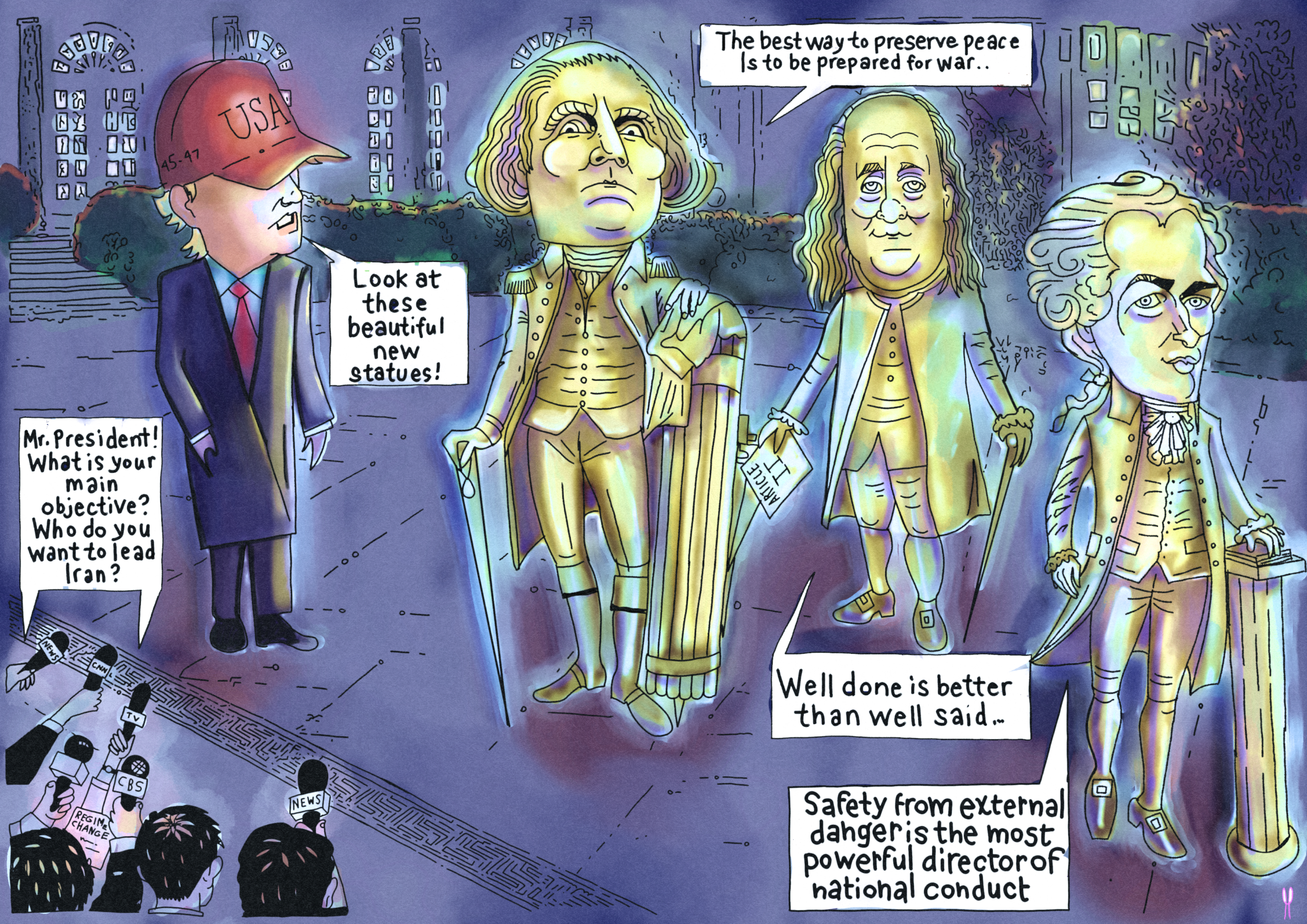
That moment became the inspiration for my latest completed political cartoon.
The Rose Garden Statue Mix-Up
Initial reports stated that the new statues installed in the Rose Garden were Thomas Jefferson and Benjamin Franklin, flanking an already present George Washington.
However, upon closer inspection of reference photographs, something did not align.
The hair.
The posture.
The facial structure.
It was not Jefferson.
It was Alexander Hamilton.
Subsequent clarification confirmed the confusion: the statue many outlets labeled as Jefferson was, in fact, Hamilton.
In a moment where the media demanded precision about war aims and foreign leadership, even the identities of the Founders were misreported.
That irony became central to the artwork. I actually had to redraw this many times.
Why Alexander Hamilton Matters
The presence of Alexander Hamilton dramatically shifts the symbolism.
Jefferson represents philosophical liberty and caution in foreign entanglements.
Hamilton represents energetic executive authority and national strength.
In Federalist No. 8, Hamilton wrote:
“Safety from external danger is the most powerful director of national conduct.”
In Federalist No. 70, he argued:
“Energy in the Executive is a leading character in the definition of good government.”
Hamilton believed that unity, decisiveness, and strength in leadership were essential during moments of foreign threat.
Placed in the Rose Garden during a geopolitical exchange, his philosophy speaks loudly.
When the Founders Answer the Press
In the finished cartoon, the press asks:
“What is your objective? Who should lead Iran?”
Trump gestures toward the statues.
The Founders answer.
George Washington
“To be prepared for war is one of the most effectual means of preserving peace.”
(Annual Message to Congress, 1790)
Benjamin Franklin
“Well done is better than well said.”
(Poor Richard’s Almanack, 1737)
Alexander Hamilton
“Safety from external danger is the most powerful director of national conduct.”
(Federalist No. 8)
Each quotation is historically authentic.
Each reframes the modern question in constitutional language.
Rather than naming leaders abroad, they speak to national preservation, executive responsibility, and deterrence.
The Visual Composition
The piece is set at night.
Cool blues and purples recede into the background, while the Founders are illuminated in warm metallic tones under dramatic monument lighting.
The press remains in shadow.
Trump stands between eras.
Washington anchors the composition centrally steady and commanding.
Franklin introduces prudence.
Hamilton reinforces executive authority.
The statues glow not theatrically, but monumentally.
History is illuminated.
A Question Larger Than the News Cycle
This cartoon is not simply about one press exchange.
It is about continuity.
The Founders debated:
- Executive power
- National security
- Foreign danger
- The limits of entanglement
Those debates remain alive today.
Questions repeat.
So do the answers.
And sometimes, the statues speak for themselves.
Categories:
Political Cartoons | American History | Executive Power | White House
