


🍺 $13 Beers and the Price of Progressivism
By Maria Grasmick
When Zohran Mamdani won the NYC mayoral race on a wave of socialist rhetoric pledging “affordability,” “free access,” and “power to the people” his supporters thought they were signing up for a revolution. What they got instead was a cash bar.
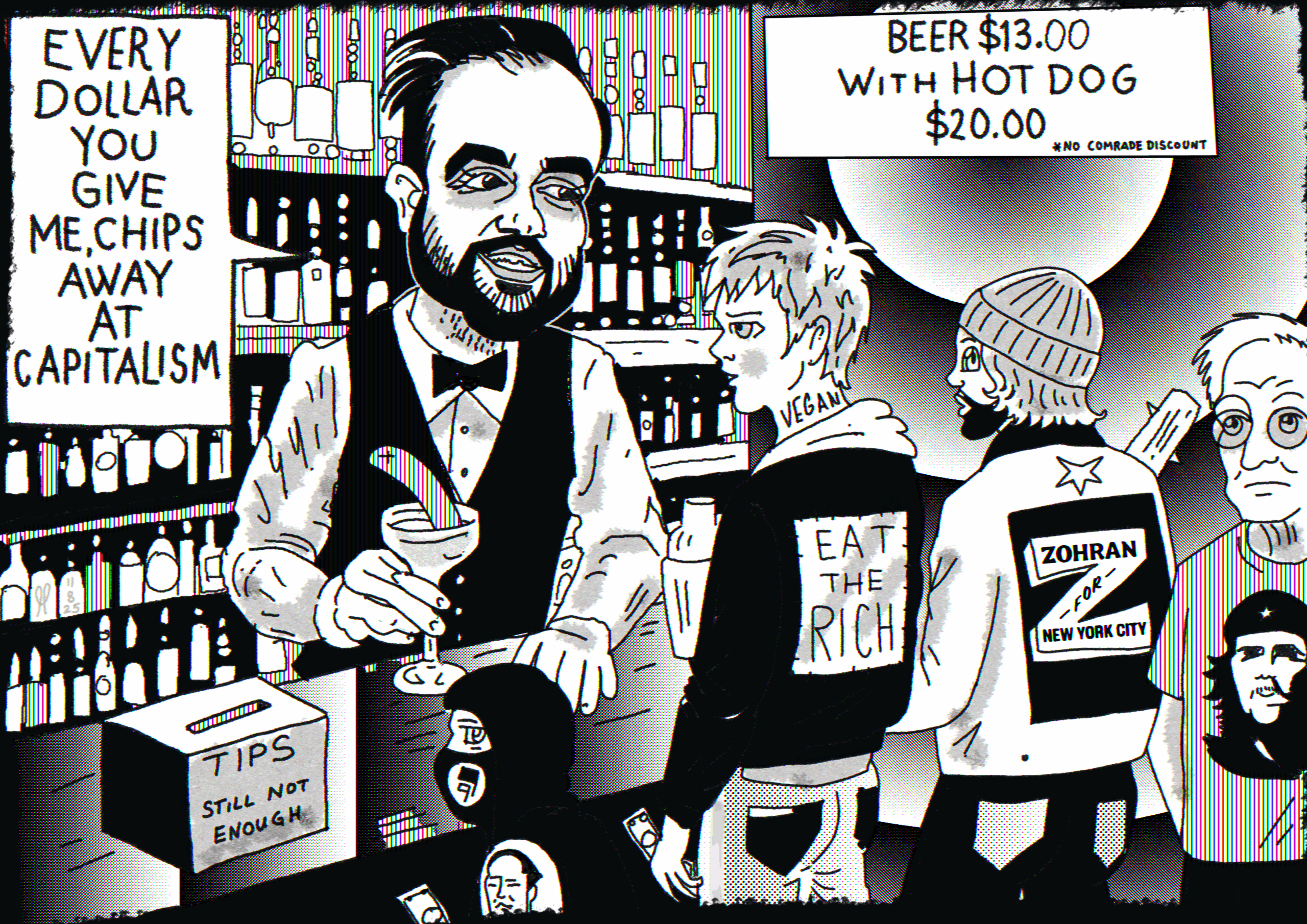
Last week, Mamdani held a victory party with drinks priced at $13 a beer or $20 if you wanted the signature “beer with hot dog in it” special ( my touch, I used to draw AOC in political cartoons serving that. It is an inside joke, with my collectors. The Hot dog in beer is like a Communism Drink special) .
Meanwhile, his campaign quietly launched a fundraising page asking supporters to help “fund his transition into office.” Because apparently, even the revolution has administrative costs.

There was no free beer. No free anything. Just the same old progressive bait-and-switch: promise the world, then pass the bill to the very people you’re claiming to liberate.

In this cartoon, I wanted to capture the absurd contradiction: a so-called man of the people running a cash bar for comrades. He’s behind the counter, cocktail in hand, preaching that “every dollar you give me chips away at capitalism” as if financial transactions are now revolutionary acts. The tip jar, labeled “Still not enough. Give more.”, says everything you need to know.
The supporters? They wear all the right symbols “Eat the Rich” jackets, Vegan neck tattoos, socialist merch but they’re still pulling cash out of their pockets, still playing along, still spending to feel like they’re resisting.
The irony isn’t just comedic it’s revealing. Because movements that promise utopia often collapse the moment they brush against reality. Mamdani’s “everything free” message was never economically coherent. And now that he’s in power, the mask slips. Prices go up. Expectations go down. The ideology doesn’t disappear it just gets rebranded and repackaged… at $13 a glass.
And yet the crowd still cheers.
Because in the end, it’s not about affordability. It’s about belonging to the right performance. And that’s exactly what this new breed of beer socialism offers: the feeling of rebellion, served overpriced and lukewarm.
No comrade discount.
I feel like this political cartoon was too easy for me. It is too simple. It is not sophisticated enough. But people always tell me , my simpler ones are the best ones. Most people cannot understand when there are so many layers, or the wit gets lost.. so. Here it is. Something easy, 12 seconds to understand. No hidden meanings or symbolism. A Very basic Cartoon.
If you want to see my sources check out my Ko-fi
TO BE FAIR TO AOC. The Hot dog in a beer wasn’t the only drink she designed


Communism is fun to make fun of. It is SO pathetic and sad. Does Zohran really believe he is a communist of the type in DEMONS by Dostoevsky? In America? They are just wannabe’s!
Communism has always offered rich material for satire .. not just because of its history of failure, but because of how earnestly its modern champions seem to cosplay it in the most comfortable, western, bourgeois settings imaginable.
Take Zohran Mamdani.
He wants to stand shoulder to shoulder with revolutionaries of the past. He quotes Fanon, gestures vaguely toward Marx, sprinkles his campaign speeches with words like “mutual aid,” “decolonize,” “equity.” But does he really see himself as one of the ideological firebrands from Dostoevsky’s Demons? As a Pyotr Verkhovensky, plotting to upend civilization from within?
“Each generation must, out of relative obscurity, discover its mission, fulfill it or betray it.”
— Frantz Fanon, quoted by Zohran Mamdani as a personal guiding principle
WHO IS FANON?
- He became involved in the Algerian independence movement against French colonial rule.
- His most famous works are:
- The Wretched of the Earth (1961) – a manual for anti-colonial revolution
- Black Skin, White Masks (1952) – an analysis of race, identity, and the psychological damage of colonialism
- He argued that violence was necessary and even cleansing for colonized people to reclaim their dignity and identity.
- He became the intellectual godfather for many post-colonial revolutions and radical movements from the African National Congress to 1970s Black Panthers.
🌪️ Why It’s Absurd That Zohran Mamdani Quotes Fanon
Because Fanon was writing for occupied, violently oppressed peoples, living under literal foreign domination. His framework was forged in:
- Torture cells
- Guerilla war
- Cultural erasure
- Actual colonial militaries crushing native populations
Mamdani, meanwhile, is a Yale educated NYC politician…
Selling $13 beers to anarchists wearing Che t-shirts in gentrified neighborhoods.
Fanon wasn’t trying to make housing “more affordable.”
He was trying to burn down entire colonial regimes with AK-47s and bloodied fists.
So when someone like Mamdani quotes Fanon .. YES MY FRENS, it’s cosplay. COSPLAY. C O S P L A Y
It’s intellectual LARPing.
Let’s be serious.
Dostoevsky’s communist revolutionaries were radical in the truest, darkest sense: ascetic, zealous, willing to annihilate the soul of a nation to realize their nihilistic visions. They lived and breathed conviction. There was nothing performative about it. Nothing branded. Nothing cushioned.
Mamdani , the great ZOHRAN, and the TikTok socialist set around him serve revolution with an ironic mustache, pins, flyers and a QR code. Their uniforms are $80 hoodies that say “EAT THE RICH.” Their cries for liberation are funded through GoFundMe. Their movements start with slogans and end with PayPal links.
It’s not revolution. It’s roleplay.
These are not the possessed men Dostoevsky warned us about .. they’re “possessed” by memes, social media dopamine, and the ambient guilt of being too privileged to actually suffer for their beliefs. They want the aesthetic of collapse without the cost.
It’s what makes their ideology so funny and so tragic. They preach communism from the floor of Brooklyn wine bars. They demand revolution between podcast appearances. They complain about capitalism while living entirely within its softest, safest zones.
They don’t want to destroy the system. They want to influence it. Monetize it. Eventually be hired by it.
So no, Mamdani is not a character from Demons. He’s not a revolutionary. He’s an actor in America’s latest avant garde political theater. Central Casting.. A showman in a vest, charging $13 for a beer and asking his followers to “fund the movement” with tip jars and donation buttons.
There’s nothing REALLY dangerous about it .. except how many people still take it seriously.
And in that way, maybe he is like a character from Dostoevsky…
Just not the one he thinks.
WHO IS MAMDANI?
📚 Mamdani Isn’t a “PYOTR” ..He’s a Stepan Trofimovich
In Demons (The Possessed), Stepan Trofimovich Verkhovensky is an aging intellectual who:
- Loves Commie revolutionary rhetoric
- Lives off others’ generosity
- Publishes little, but talks a lot
- Believes himself vital to change .. but accomplishes nothing
He’s the ideological mascot, not the fighter. He makes elegant speeches about liberation but exists entirely within the comfort of the system he claims to despise. JUST LIKE ZOHRAN.
Mamdani mirrors Stepan, not Pyotr the radical:
- He quotes Fanon in speeches, but charges $13 for beer at a victory party.
- He claims anticapitalism, while running a NYC campaign funded by donations and backed by institutional leftism.
- He plays revolutionary, but only where it’s safe Twitter, city council, Ivy League schools, and personal salons.
🧥
ZOHRAN ALSO RESEMBLES:
🎭 Tom Ripley (The Talented Mr. Ripley) ..Spiritually
The charming outsider who reinvents himself for personal gain.
🥀 ZOHRAN is just like GONZALO MORE, A Study in Emotional Fraud, Anaïs Nin & Her Communist Lover ..
Anaïs Nin’s journals describe her Communist lover, who they lived on a houseboat together. She bought him a press to write his manifestos and communist news, but he never used it..because he was SO LAZY! Nin financially backed the Communist writing project he was slothlike and slovenly… a quiet irony: those who profess to lead change often rely on others’ money and labour. Disappointment, as she wrote:
“A man who spoke of revolution but was driven by personal resentment. His anger was not against injustice, but against his own smallness in the world.”
“He dressed his impotence in Marxist words.”
This man wanted not to rebuild society but to be important without earning it. He was seductive in speech, theatrical in cause, but passive, demanding, weak. He cloaked his failures in communist socialist ideology.
🪞 Mamdani Mirrors This Precisely:
- He doesn’t want equality .. he wants recognition, admiration, worship.
- His “movement” isn’t built on principle, but on the performance
- Like Nin’s lover, Mamdani is a parasite of energy .. feeding on the idealism of others, while giving little beyond words and spectacle.
Anaïs saw it clearly:
“He wants to destroy the world that never noticed him.”
That’s Mamdani quoting Fanon, selling socialism, basking in applause but ultimately building nothing but his own persona. His revolution is just a mirror.
What about the Communist Arthur Miller? Is Zohran Mamdani just like him?
Marilyn Monroe loved famous COMMUNIST Arthur Miller not as a symbol, but as a man. She stood by him when he was subpoenaed by Congress for his Communist ties, shielding him with her fame, her loyalty, and her untouchable glamour. She helped save him from prison, from blacklisting, from political exile. And how did he repay her? With PAIN and Disappointment. He wrote The Misfits, a film meant for her but scripted like a eulogy, full of mockery, veiled contempt and tragic symbolism. He later smeared her memory in his plays, casting her as the unstable burden. To his dying day, he put her down as a woman. Marilyn Monroe signed up for love, for art, for purpose. What she got was betrayal, the same trade so many make when they fall for men who call themselves revolutionaries. They come bearing promises of justice, but leave only with your reputation, your energy, and your story rewritten.
Communists can’t be trusted with your money or your love. They promise liberation, but spend your affection like currency, and your trust like it’s their collective property. They will share YOUR STUFF. Not theirs.. And the common good, means everyone else but yours.